Moon Phases, Explained: What Each Phase Is (and Isn't) Telling You
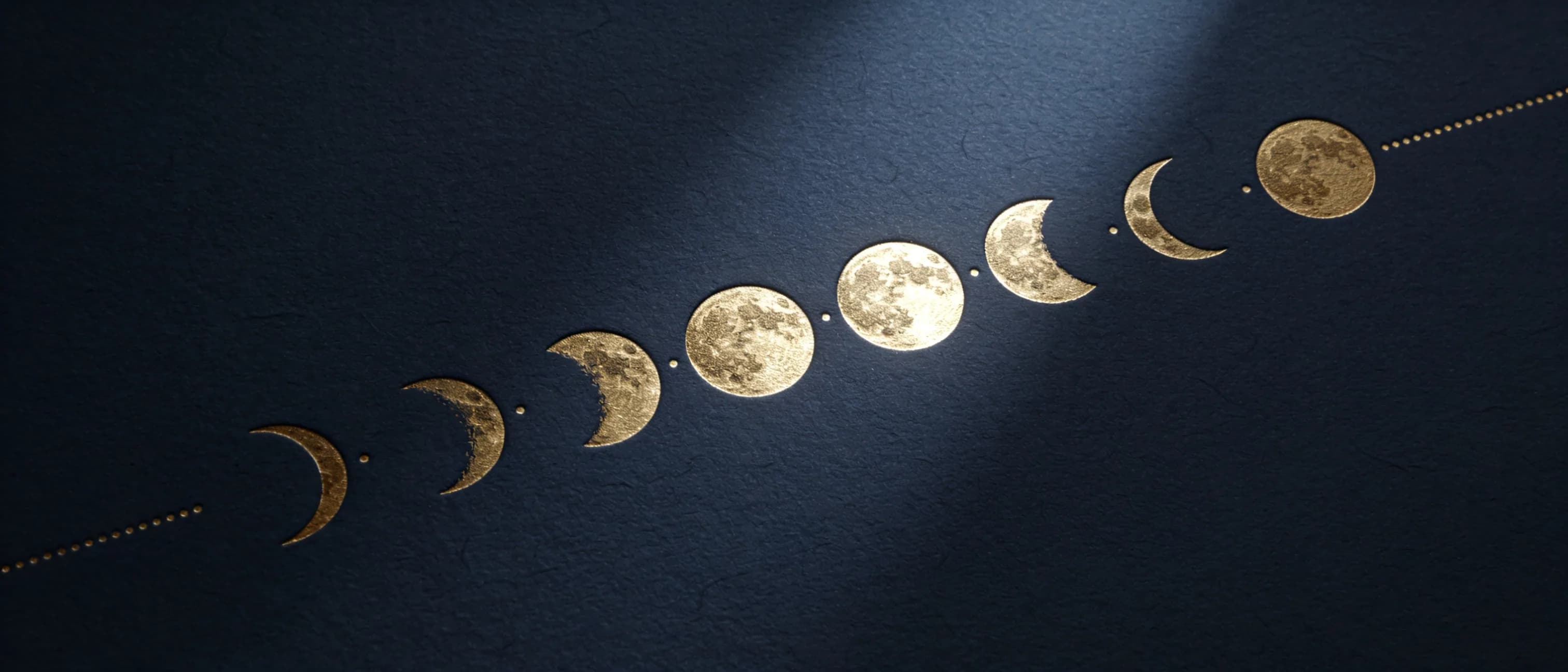
Every 29.5 days the Moon runs the same quiet loop: dark, growing, full, shrinking, dark again. Humans have hung meaning on that loop for at least as long as we've had writing. This guide gives you both layers — the astronomy that's simply true, and the symbolism that's useful as a mirror, phase by phase.
One honest note before we start: the Moon does not decide anything about your day. What it offers is a rhythm — and a rhythm is a remarkably good scaffold for reflection. (Why reflection beats prediction →)
The astronomy in one paragraph
The Moon produces no light of its own; we see whatever slice of its sunlit half happens to face Earth. As the Moon orbits us, that slice grows ("waxing") from new to full, then shrinks ("waning") back to new. The whole cycle — a synodic month — takes about 29.5 days. That's it. Everything else is interpretation.
The eight phases, as reflection prompts
🌑 New Moon — the dark start. Traditionally: beginnings, intention-setting. As a prompt: what would I start if nobody was watching? The sky is dark; nothing is announced yet. Good week for private commitments.
🌒 Waxing Crescent — first light. Traditionally: hope, fragile momentum. Prompt: what tiny evidence exists that the new thing is real? Protect small starts from big opinions.
🌓 First Quarter — half-lit, climbing. Traditionally: friction, decision. The half-moon is a fork drawn in the sky. Prompt: where am I waiting for permission I could give myself?
🌔 Waxing Gibbous — almost. Traditionally: refinement, patience. Prompt: what needs one more honest pass before it's shown? The urge to ship early and the urge to polish forever both spike here — notice which one is yours.
🌕 Full Moon — everything visible. Traditionally: culmination, high tide of feeling. Prompt: what has quietly finished, and did I mark it? Full moons are less about drama than about visibility — things you've been ignoring become hard to ignore.
🌖 Waning Gibbous — the exhale. Traditionally: gratitude, sharing. Prompt: what did the last two weeks teach me that someone else could use?
🌗 Last Quarter — half-lit, descending. Traditionally: release, pruning. Prompt: what am I still carrying purely out of habit? The mirror-image of First Quarter's decision: not "what do I choose?" but "what do I retire?"
🌘 Waning Crescent — the quiet end. Traditionally: rest, surrender. Prompt: what does rest actually look like for me — and when did I last do it on purpose? The cycle ends where it began: in the dark, where new intentions grow.
How to actually use this
Don't memorize eight meanings. Do one thing: when you notice the Moon tonight, ask its phase's question and answer honestly — out loud, in your head, or best of all in writing. A written answer becomes a record; thirty written answers become a pattern. That's the entire engine of the 3-minute moon ritual: morning Signal, one small step, evening Echo.
What the phases can't tell you
They can't tell you whom to trust, when to invest, or whether to text back. Anyone selling certainty on the Moon's schedule is selling their certainty, not the sky's. The phases offer cadence, not commands — and honestly, cadence is the rarer gift. Most of us don't lack instructions; we lack a rhythm for listening to ourselves.
Lunara turns this cycle into a daily practice: each morning it reads today's Moon against your own birth chart and hands you one Signal — a question shaped for you — and each evening your Echo writes the real answer. Free tier, full practice, no card.